Most people don’t fail to make progress because they lack ambition.
One key reason they fail is because their goals exist in vague abstractions. They know what they want in theory, but when the day begins, they’re forced to decide what to do next over and over again.
They move through the day without a clearly defined vision shaping what they do.
That decision friction compromises motivation — and reduces the chances of them actually making progress in their goals and lives.
It also makes it more likely for them to be pulled away by random distractions that just waste their time.
A well-designed daily planner / operating system is a powerful tool that solves all these problems.
Your daily operating system
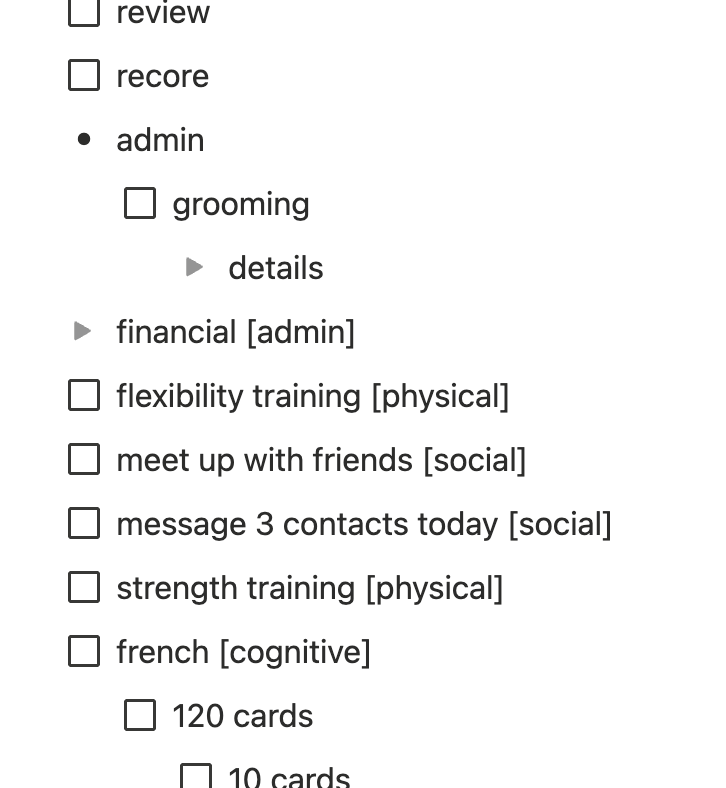
There was once a time where i never used any daily planner, but now I can’t imagine moving through my day without it.
I call it a daily operating system — not because it controls your life, but because it gives structure to execution.
Goals stop being distant intentions and become concrete actions — that will be done.
The planner becomes the place where intention turns into movement.
Why a daily planner / OS
A good daily operating system doesn’t just organize tasks. It reduces mental overhead and creates continuity between days.
1. You always know what to do (focus)

When your day is pre-structured:
- You don’t waste energy deciding what deserves attention.
- Transitions between tasks become smoother.
- You don’t randomly get pulled away by an “urgent” task
- Starting becomes easier because the next action is already defined.
This removes the constant low-level negotiation with yourself about what matters most right now.
2. You maintain high-level control of your day
Control doesn’t mean rigidity. It means direction.
A planner gives you a clear view of how your day fits into your larger life.
Instead of holding everything in your head — unfinished tasks, future plans, competing priorities — the structure exists outside of you.
This creates a powerful sense of totality and calm.
You’re no longer guessing whether you’re doing enough or forgetting something important, because the overview is visible.
A planner lets you:
- Allocate time intentionally instead of reacting to circumstances.
- Ensure important goals are touched daily or weekly.
- Prevent urgent but unimportant tasks from consuming everything.
You’re steering the day rather than being carried by it, with the reassurance that your actions are aligned with where you want your life to go.
3. You experience continuous accomplishment

Large goals are psychologically distant. Daily progress is not.
Completing small, clearly defined actions creates:
- Visible progress
- Momentum throughout the day
- A reinforcing sense that your life is moving forward
Mini-wins accumulate into long-term change.
How to build your own daily OS
The goal is not complexity. It’s clarity.
Use a flexible workspace, not just a to-do list
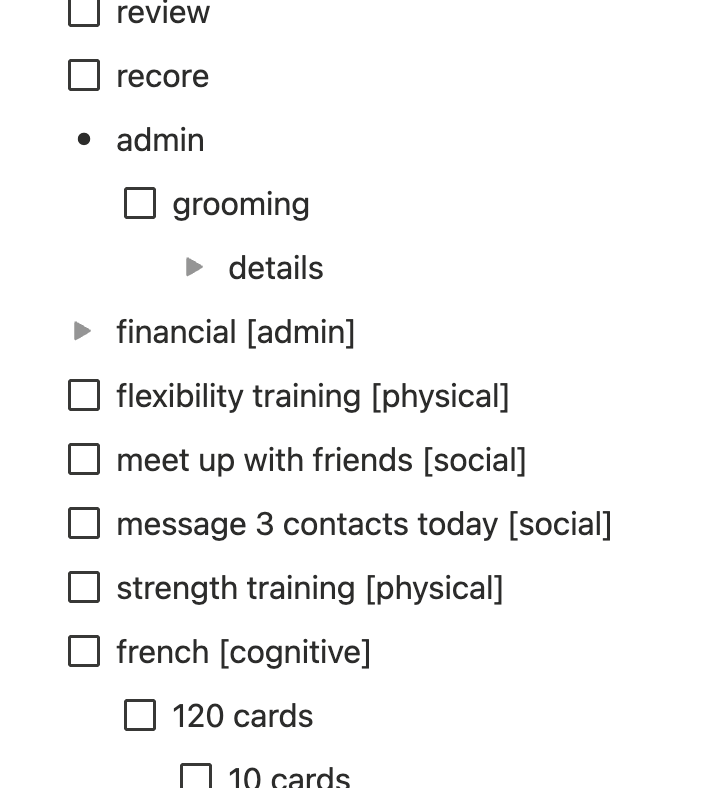
Simple to-do apps often flatten everything into equal importance.
A planner should reflect structure.
Tools like Notion work well because they allow:
- Categories
- Hierarchies
- Context around tasks
- Long-term and daily views in the same system
The planner becomes a map, not just a checklist.
Categorize into key goal areas
Instead of one endless list, divide tasks by the areas you want to grow.
- Meta (job, daily reviews, admin, reminders, etc.)
- Social: relationships, social events, etc.
- Physical: workouts, etc.
- Cognitive: learning, chess, etc.
- Creative: Movie script writing, building a business, etc.
- Emotional
This ensures progress happens across your whole life rather than only where urgency pushes you.
Atomize your goals
Large goals create resistance. Atomic actions create movement — and stronger sense of “this is what i need to do next”
For example, practiced learned words is a key task I do everyday as I learn French.
So instead of just:
- “Practice 120 words”
I’ll break it down into multiple sub-tasks:
- Practice 10 words
- Practice 10 words
- Practice 10 words…
- etc.
It looks like it shouldn’t matter, but one is much more likely to make me want to take action.
“Practice 10 words” is much more atomic — without being too little that it doesn’t feel like i did anything.
Atomic tasks are:
- Small enough to start immediately
- Clear enough to complete in one session
- Specific enough to measure progress
Rank goals by importance
Not all goals deserve equal weight at the same time in any given day.
Each day:
- Decide which goals currently matter most for your long-term direction.
- Let those goals shape what earns space in your day.
- Accept that some goals will temporarily move slower so the right ones can move faster.
Progress comes from consistently advancing the most important goals, rather than trying to move everything forward equally.
Connecting the planner to real life
A planner only works if it survives contact with reality.
The mistake many people make is designing perfect days that collapse when friction appears.
Use the goal → meta → goal structure
Instead of stacking demanding tasks back-to-back:
- Work on an important meaningful goal in the daily OS list — an atomic task for example
- Take a break and switch to a lighter or foundational meta task (responding to messages, managing your tools, recurring goals like grooming, etc.)
- Return to another meaningful goal
This rhythm allows recovery without losing momentum.
Meta tasks act as buffers that keep the day moving.
Your daily OS is also a journal
Your daily OS doesn’t just reflect your actions, it also reflects your lived moments within the day.
Execution improves when awareness is present.
For example you could add short sentence inside or after tasks such as:
- “Felt really focused for this, wow”
- “Hard to start but got easier after 5 minutes.”
Over time, these small notes turn your daily OS into a record of the day itself — not only what was completed, but how it felt to move through it.
The planner stops being just a tool for organizing actions and becomes a place where progress and experience sit side by side, quietly documenting the rhythm of your life as it unfolds.
And then you can also use these notes as feedback when reviewing your day.
The real purpose of a daily OS
A daily planner is not about productivity for its own sake. It’s about alignment.
When your goals, actions, and days connect, progress stops feeling accidental. You start channeling your motivation reliable using the well-built structure.
And when structure is consistent, progress across multiple areas of life stops competing for attention — it becomes the natural result of how your days are designed.