If you don’t design your social media feed, algorithms will design it for you.
And those algorithms are not optimized for human flourishing. They are optimized for attention — which means outrage, distraction, and addictive entertainment.
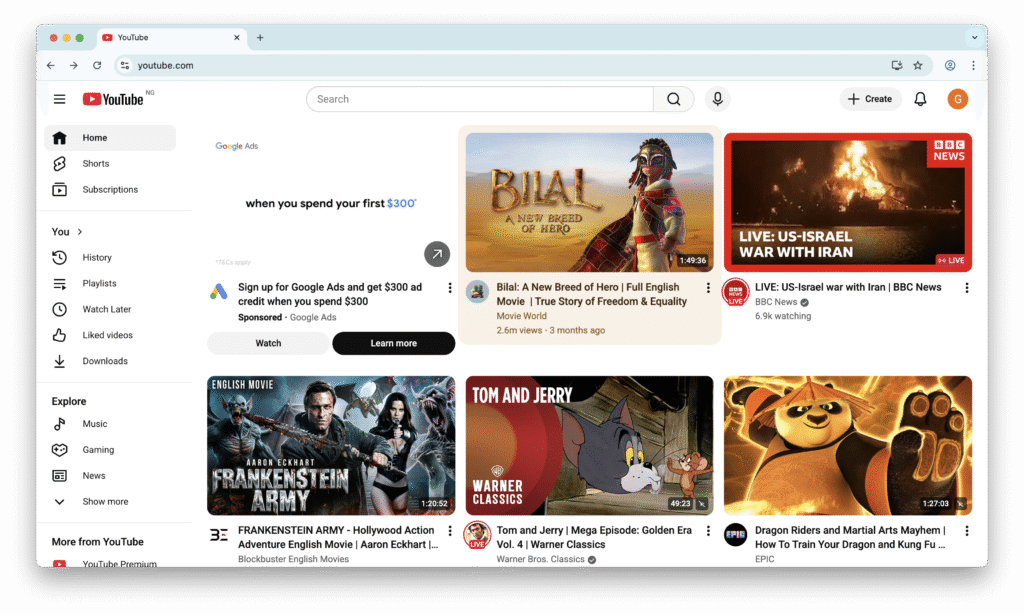
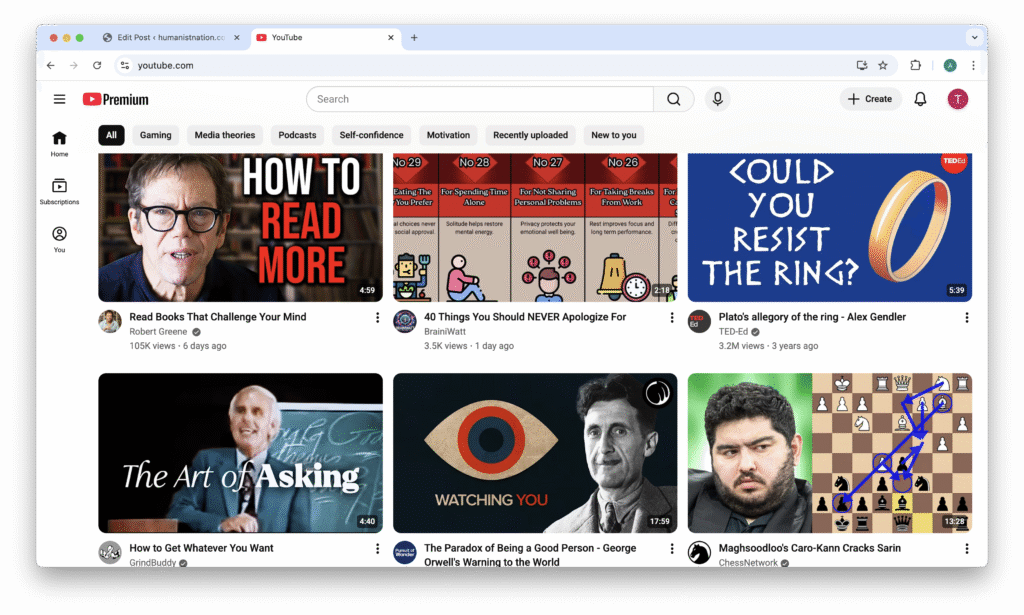
Feed of the average distracted person — endless entertainment, endless negative news, hyperoptimized content to capture our attention and gradually waste our days with doomscrolling and binge watching:
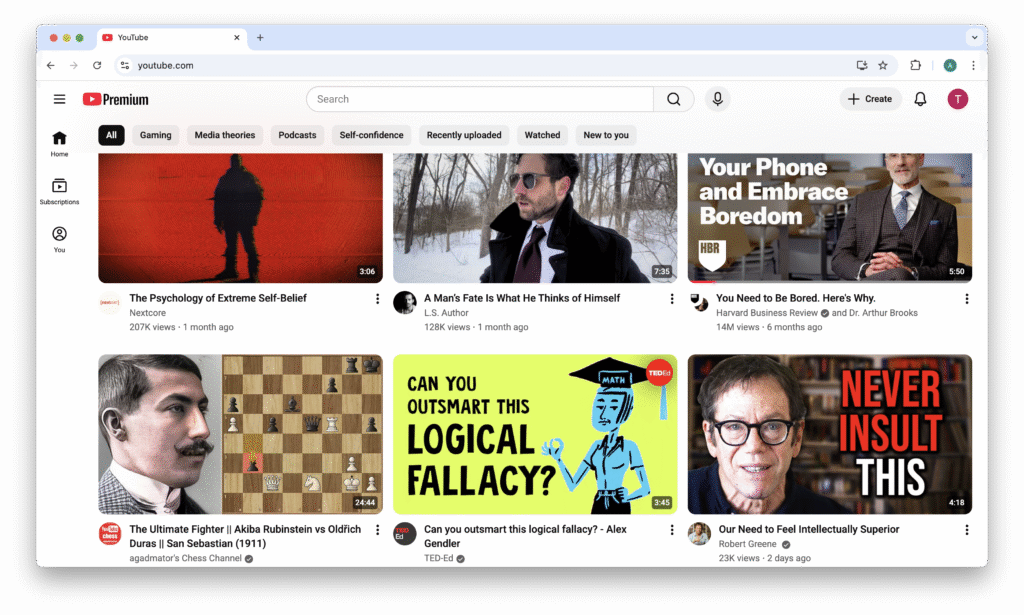
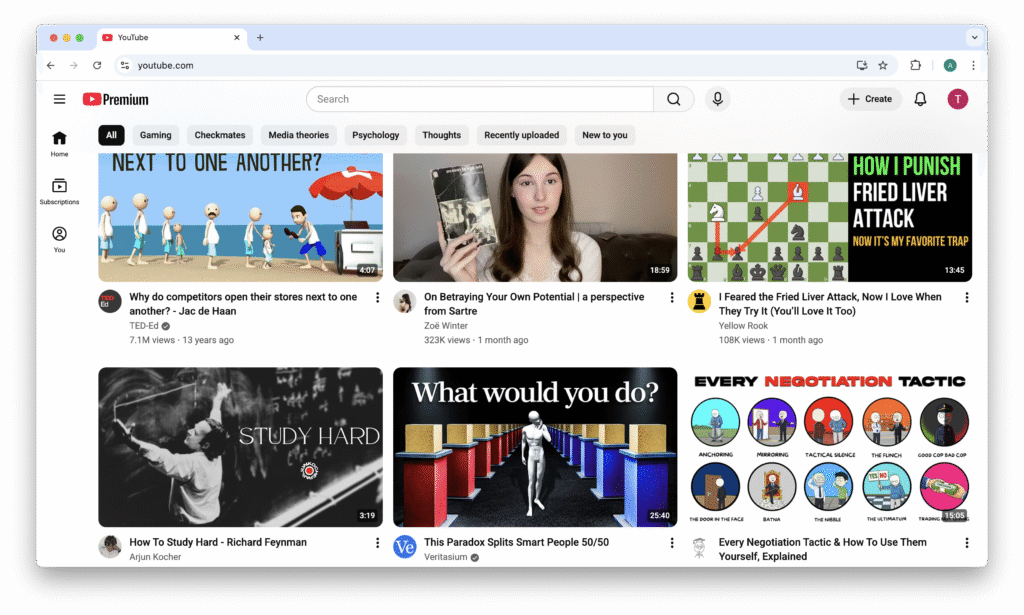
Feed of the extraordinary human, the Humanist — content that inspires, educates and nurtures the mind — while still being interesting:
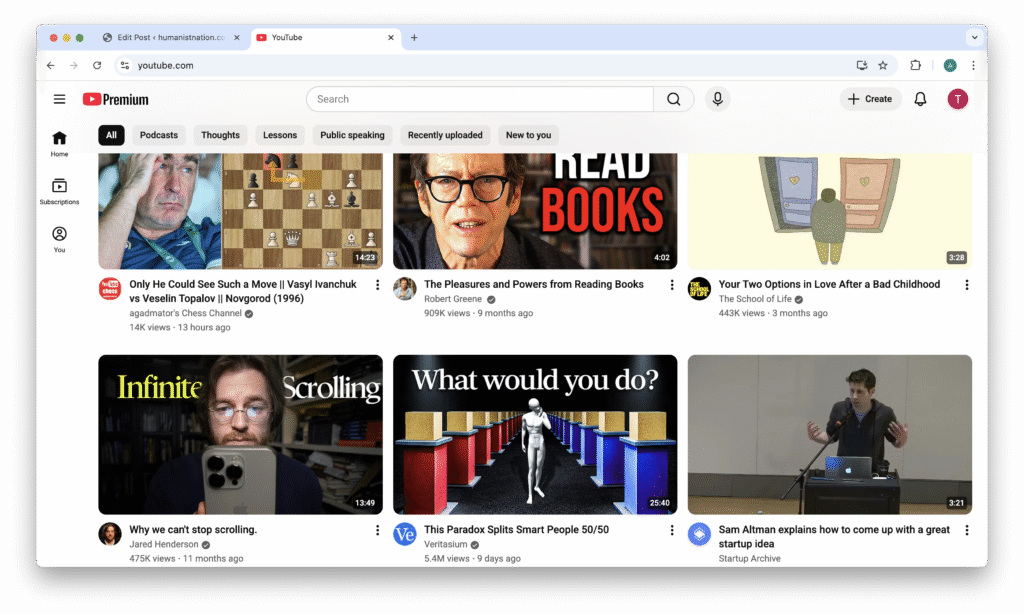
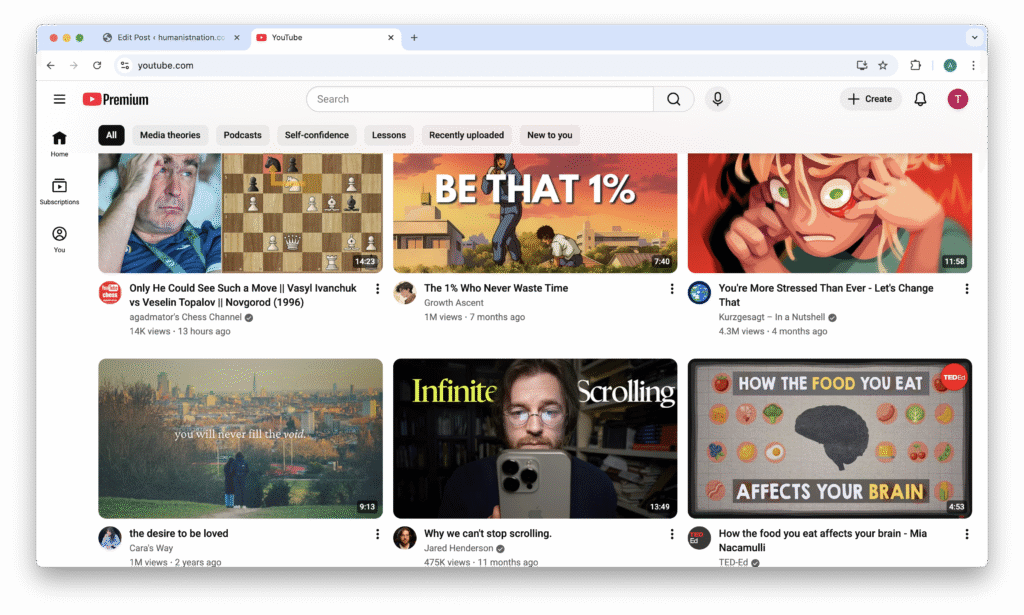
Over time, this algorithm design turns many people’s social media feeds into a kind of mental junk food diet.
Humanists reject this passive relationship with technology. They don’t reject social media as “harmful” outright.
But they treat their social media feeds as something that should be intentionally curated and aligned with human development.
They make the algorithm serve them, instead of being a slave to it.
Your feed is your attention diet
Most people treat social media as harmless entertainment. But the reality is that your feed functions as an attention environment that quietly shapes the way you think and the trajectory of your days.
Distracting entertainment-centric social media feed:
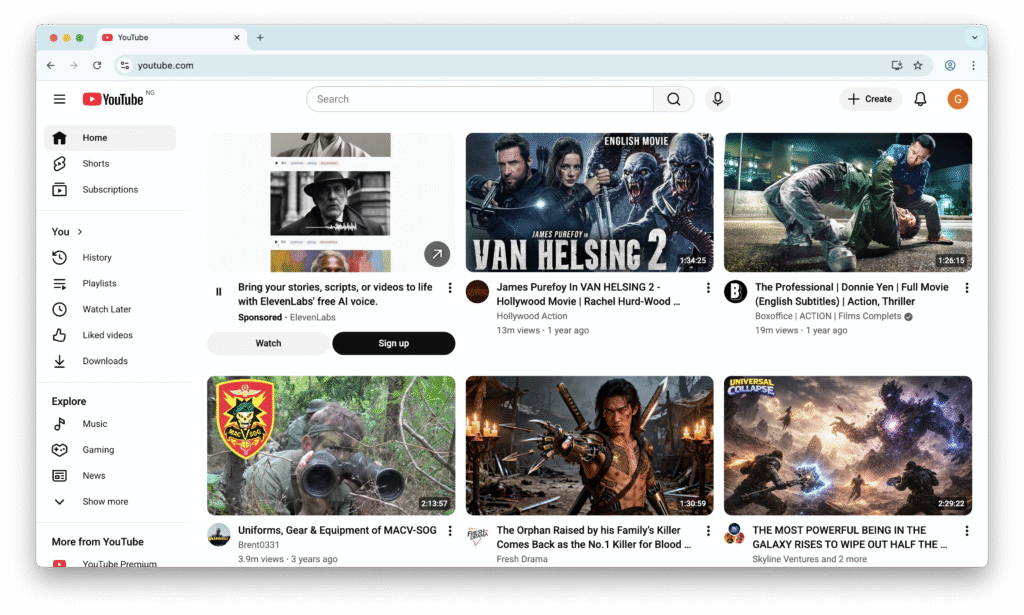
Humanized empowering feed:
What you repeatedly see influences:
- the ideas you encounter
- the behavior you normalize
- the ambitions that feel possible
- the emotions that dominate your day
- how interested you are in your own life
- how prone you are to doomscrolling and mindless entertainment
Just as food shapes the body, content we consume shapes the mind. If someone spends hours each day consuming outrage, drama, and shallow entertainment, it inevitably affects how they think and what they aspire to.
Your feed is essentially your attention diet.
And like diet, most people’s is extremely unhealthy.
The problem with the default feed
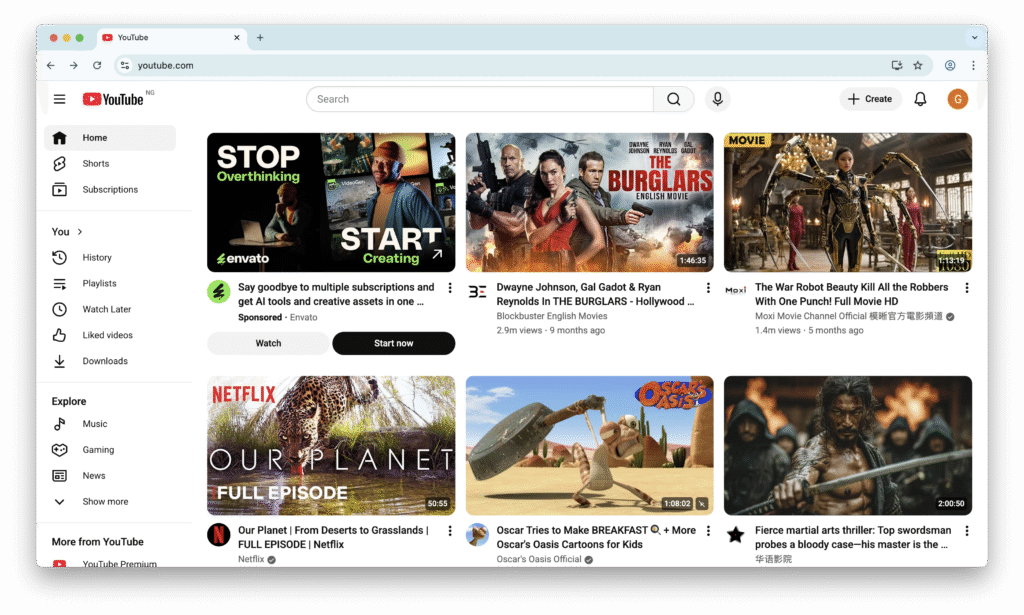
Modern social media platforms are optimized for engagement, not human development.
Algorithms promote content that triggers strong reactions, which often leads to feeds dominated by:
- outrage and relentless negative news cycles
- gossip and drama
- addictive short-form entertainment
- endless distraction
- curiosity bait that sparks interest but adds no meaningful value
This environment pulls people toward passive consumption and constant stimulation. Instead of encouraging curiosity, ambition, or growth, it often trains users to become spectators of life.
Humanists reject this entertainment-centric model.
Enjoyment should not come from endless distraction. It should come from engaging with meaningful and stimulating content — ideas, human achievement, intellectual challenge, and excellence.
A humanized feed
A humanized social media feed exposes you to human excellence across multiple dimensions of life.
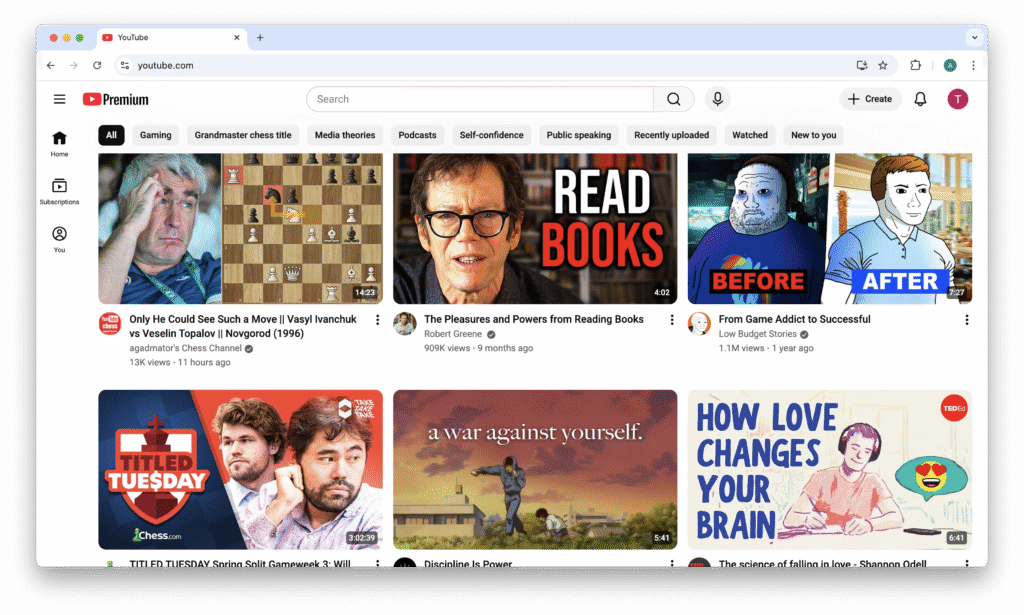
Content that makes you aspire to better, and content that teaches you how to better.
Rather than allowing algorithms to dictate your online attention environment, you deliberately curate it to nourish different aspects of human development.
Meta
This is content that shapes your worldview, plans, and life orientation.
Examples:
- content that teaches critical thinking
- motivational content
- financial literacy and life strategy
This category helps you interpret reality more clearly and think more deliberately about how you want to live.
Social
Content that improves your understanding of people and helps you interact with them better.
Examples:
- content on psychology and social intelligence
- overcoming social anxiety
- advice on building and maintaining friendships
Social skill is one of the most important abilities a human can develop, yet it is rarely taught directly. A humanized feed exposes you to ideas that strengthen social awareness and communication.
Emotional
Content that helps you develop emotional awareness and resilience.
Examples:
- therapists or psychologists explaining emotional patterns
- personal stories about overcoming hardship
- reflections and advice on handling anxiety, rejection, or setbacks
- discussions on motivation and discipline
This type of content helps people better understand their inner lives and develop the emotional strength needed to face challenges and pursue meaningful goals
Cognitive
Content that challenges the mind.
Examples:
- chess and strategic thinking
- debates and argument analysis
- puzzles and problem solving
This type of content stimulates intellectual curiosity and strengthens reasoning ability.
Physical
Content that celebrates the human body and physical excellence.
Examples:
- sport highlights that showcase extraordinary athletic performances: e.g., football
- impressive displays of skill: calisthenics, flexibility, etc.
- guidance on improving physical appearance and presentation
Seeing examples of physical mastery can inspire people to develop their own strength and athletic ability.
Creative / Builder
Content showing humans creating and shaping the world.
Examples:
- creative work
- engineering and startups stories
- scientific research
This type of content reminds us that humans are not merely observers of reality — we are capable of building, discovering, and transforming the world.
How to transform your online attention diet
Modern social media feeds are no longer primarily based on who you follow. Most are discovery-driven systems where algorithms decide what content you see.
This means the goal is not just to curate accounts — it is to actively shape the algorithm itself.
Avoid environments engineered for distraction
Short-form scrolling feeds such as TikTok, Instagram Reels, and YouTube Shorts are the hardest environments to humanize.
These platforms are engineered for endless novelty and compulsive consumption. Even if valuable content exists there, the architecture of the feed constantly pushes users toward distraction.
For many people, the simplest way to protect their attention environment is to remove these feeds entirely.
Reset your feed if necessary
If your feed is already dominated by low-quality content — drama, outrage, or endless entertainment — it may be easier to reset the algorithm.
Possible ways to do this include:
- creating a new account
- clearing watch history
Think of this as wiping a polluted attention environment so you can rebuild it intentionally.
Train the algorithm deliberately
Discovery-based feeds learn from your behavior.
Every action sends a signal:
- what you watch fully
- what you skip
- what you like or save
- what you search for
Humanists use this to their advantage.
Instead of passively consuming whatever appears, they train the algorithm by intentionally engaging with content aligned with human development:
- philosophy
- psychology
- science
- debates
- athletic excellence
- creative work
- engineering and discovery
Over time, the feed begins to surface more of that content.
Just as importantly, you can send negative signals to the algorithm. Many platforms allow you to hide or dismiss content you don’t want to see — for example by using options like “Not interested” on YouTube.
These signals help the system learn what kinds of content should not appear in your feed.
By consistently reinforcing the right signals — both positive and negative — you gradually reshape the algorithm into a feed that reflects the environment you want to live in.
Starve the algorithm of junk signals
Algorithms promote what receives engagement.
So one of the most important habits is not interacting with low-quality content at all.
Avoid:
- watching drama or outrage videos to the end
- engaging with ragebait
- pausing on distracting content
Even negative engagement trains the algorithm to show you more of the same.
If something does not belong in a humanized feed, scroll past it immediately.
Use search intentionally
Discovery algorithms are strongly influenced by search behavior.
Instead of relying entirely on the default feed, periodically search for topics aligned with human development, such as:
- philosophy
- psychology
- scientific ideas
- athletic training
- engineering or startups
Watching several pieces of content in these areas sends strong signals to the algorithm about what you want your feed to contain.
Follow creators after discovery
Once you discover high-quality creators through the algorithm, then following them becomes useful.
Over time, your feed becomes a hybrid:
- discovery surfaces new ideas
- your following list anchors the feed around reliable sources
This combination produces a much healthier attention environment.
Periodically retrain the feed
Algorithms constantly adapt, and lower-quality content can creep back in.
Occasionally repeat the training process:
- search intentionally
- engage with high-quality content and dismiss low-quality content
- ignore distractions
Treat your feed like a system that requires maintenance, not a passive stream of entertainment.
Designing the environment that shapes you
The goal of humanizing your social media feed is not merely to improve how you use technology.
It is to redesign the environment that shapes your mind every day.
A well-curated feed surrounds you with ideas, excellence, curiosity, and human achievement. Over time, that environment influences what you value, what you pursue, and ultimately the kind of person you become.
If algorithms can shape millions of minds through passive feeds, then intentional curation can do the opposite.
Humanists choose not to let algorithms decide what fills their attention.
They design their attention environment themselves.